Pickleball brings generations together: learned in minutes, easy on the joints and hugely social. This guide explains step by step — with graphics — how it works, which rules really matter and how to get started with us in Derendingen near Solothurn.
What is pickleball?
Pickleball combines elements of tennis, badminton and table tennis. It's played with a solid paddle and a light plastic ball with holes — usually as doubles. Because the ball is slower and the court small, real rallies happen from the very first session.
It was invented in 1965 on Bainbridge Island near Seattle (USA) by three fathers looking for a summer game for their kids. Today it's one of the fastest-growing sports in the world, Switzerland included. Racket City is an official partner of Swiss Pickleball.
Equipment
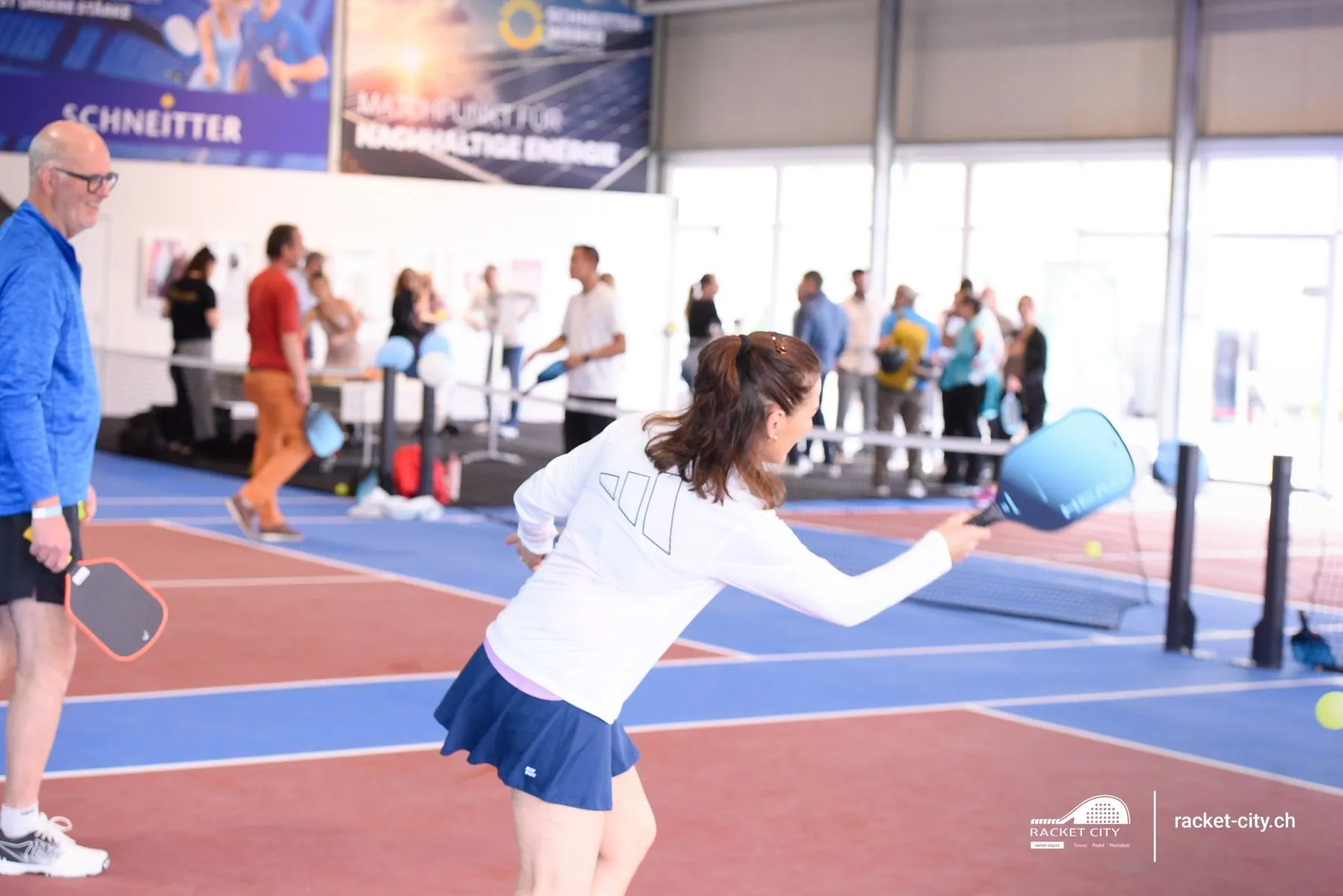
You don't need much: a paddle, a ball and good indoor court shoes. The paddle has no strings and is smaller and lighter than a tennis racket. The plastic ball has holes — indoor balls are softer, outdoor balls harder.
At Racket City you can rent paddles from the machine for CHF 5.
Paddle
- No strings, solid face
- Smaller than a tennis racket
- Light: usually 200–250 g
Ball
- Plastic with holes
- Slower than a tennis ball
- Indoor and outdoor balls
Shoes
- Indoor court shoes
- Lateral support matters
- No running shoes
The court and the kitchen
A pickleball court is 13.41 × 6.10 m — exactly a badminton doubles court. The net is 86 cm high in the centre and 91 cm at the posts.
What makes it special is the kitchen: the 2.13 m non-volley zone on each side of the net. Behind it, the centreline splits each side into left and right service courts.
- Court: 13.41 × 6.10 m
- Net: 86 cm centre, 91 cm posts
- Kitchen: 2.13 m each side
- Lines are in — except the kitchen line on the serve
The serve
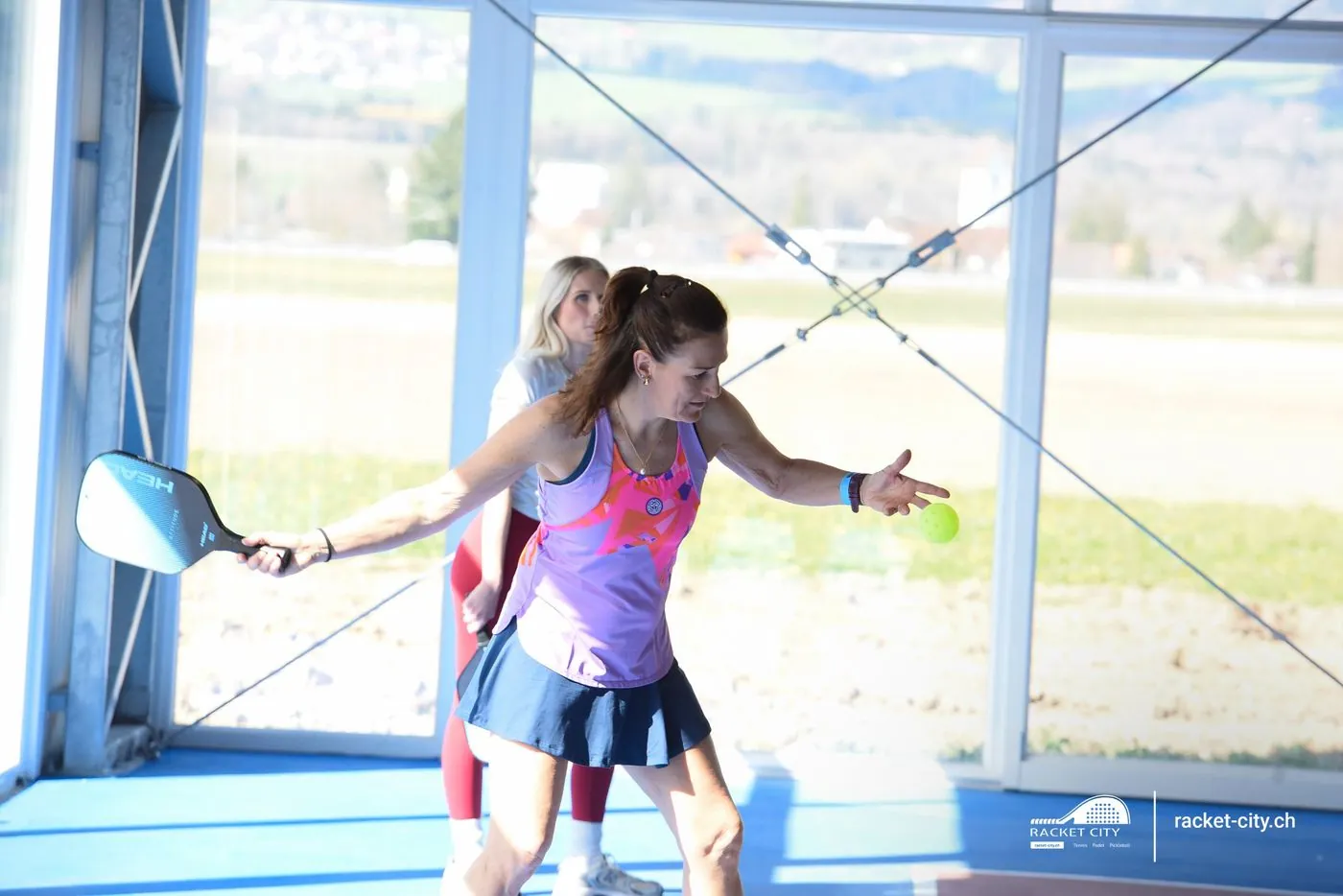
The serve is underhand and diagonal: from behind the baseline, over the kitchen into the opposite service court. Contact is below the waist with an upward swing.
The drop serve is also allowed: drop the ball and hit it after the bounce. One attempt per serve; a ball in the kitchen or on its line is a fault.
- Underhand, below the waist
- Diagonal
- Not into the kitchen
- One attempt only
The two-bounce rule
After the serve, the ball must bounce once on each side: the return is played after the bounce, and the serving team also plays the return after the bounce.
Volleys are only allowed from the fourth shot on. This stops the serving team rushing the net and makes rallies longer.
Serve
must bounce
Return
must bounce
3rd shot
must bounce
Then free
volleys allowed — except in the kitchen
Kitchen rules in detail
You may not volley inside the kitchen. You can step in at any time — for example to play a short ball after it bounces. The line counts as part of the kitchen.
A common beginner fault: momentum carrying you into the kitchen after a volley — that's a fault even if the ball has gone.
- No volleys in the kitchen or on the line
- Entering is fine if the ball bounces there
- Momentum after a volley counts
- Step out before you volley
How scoring works
Games go to 11, win by two. Traditionally only the serving team scores.
In doubles the score is called with three numbers: your score, the opponents' score and the server number. Games start at '0 – 0 – 2'.
The key shots
Pickleball is a game of control more than power. These are the five shots to know — with their typical flight path from the side.
Dink
Short, soft ball into the opponents' kitchen. Your key weapon at the net.
Third Shot Drop
High, soft third shot landing in the kitchen — your way to the net.
Drive
Flat, fast shot from the back to put pressure on.
Lob
High ball over opponents at the net.
Smash
Powerful overhead on a ball that's too high.
Tactics for beginners
Golden rule: whoever controls the kitchen line controls the game. Get up there with your partner quickly and be patient in the dink rallies.
- Serve and return deep
- After the return, move up to the kitchen line
- Serving team: use the third shot drop
- Dink patiently
- Aim at the feet
Typical beginner mistakes
Almost every beginner makes the same mistakes at first:
- Hitting too hard
- Staying at the baseline
- Forgetting the two-bounce rule
- Falling into the kitchen
- Calling the score wrong
Getting started at Racket City
At Racket City in Derendingen you play on dedicated courts, indoors and outdoors. Book via Playtomic, rent a paddle and go.
For structured learning, start with an Academy course. For companies, clubs and families, it's the ideal team event.
- Book via Playtomic
- Rental paddle: CHF 5
- Academy courses
- Ideal for team events and families